Diesel Locomotive Maintenance, Servicing & Technical Fault Finding

Maintenance & Servicing

We carry out on-site maintenance checks against schedules produced by our customers or ourselves, recording the tasks through checklists and descriptions of any defects and repair work. Servicing work can include oil and filter changes, brake block changes, greasing and top-up of oil and coolant. Materials can be provided by ourselves or from the customer’s stocks and must conform to recognised quality standards.

Technical Fault Finding

We can also investigate faults that may be proving difficult to trace, typically in electrical and braking control systems, and typically due to long term ageing or corrosion of components, wiring etc. We have freely helped many loco owners with their fault finding simply over the phone or by email. Exchange of experience and lessons learned between owners and operators is vital for the continued operation of heritage locos.

Examples of recent maintenance, servicing and fault finding schedules

Class 47 Annual Service

For the last two years, we have carried out a pre-season annual service check for the owners of loco 47292 based at Great Central Railway Ruddington. This comprises a safety check of bogie and brakegear, greasing bearings, topping up oil and coolant, and running checks of the brake and traction equipment. The air and vacuum braking pressures are checked and adjusted using calibrated pressure gauges. We provide a signed-off checklist and details of tasks carried out.

Class 37 Maintenance Schedule

We have drawn up a maintenance schedule for the owner of loco 37688 based at the Severn Valley Railway. The starting point for this was the original BR mainline schedule, re-cast to enhance the checks on a monthly basis. Although much of the maintenance is being done by SVR staff, we provide additional engineering staff so that the time spent in the diesel depot is kept to a minimum and the loco returned quickly to service.

Starting problems with Class 44 loco

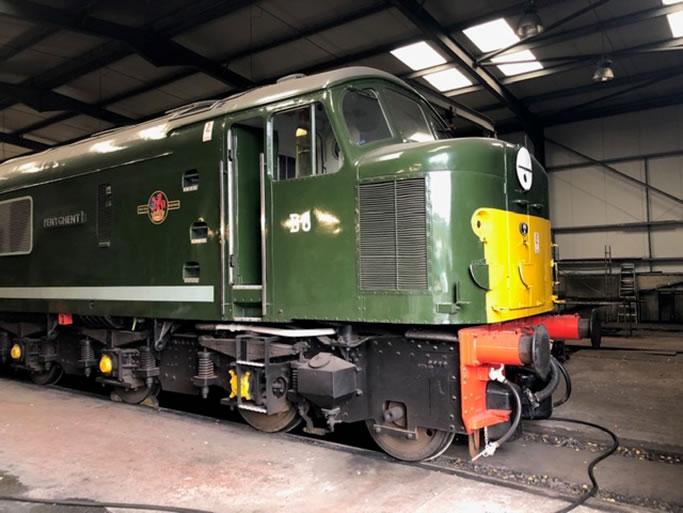
We are frequently called to advise and investigate starting problems with heritage locos. From our experience of this over many years, we have found this is often due to problems with electrical starting contactors. These carry a heavy current across moving copper contacts, which heat up and become pitted with arcing. This was the case when we examined D8 which was suffering intermittent starting problems. It was found that one set of contacts was partly worn down and the tips were no longer being pressed together by the air actuator. By resetting the contacts, the problem was cured. There was no charge for our help.

Showing Slide 1 of 3
Scroll to Top